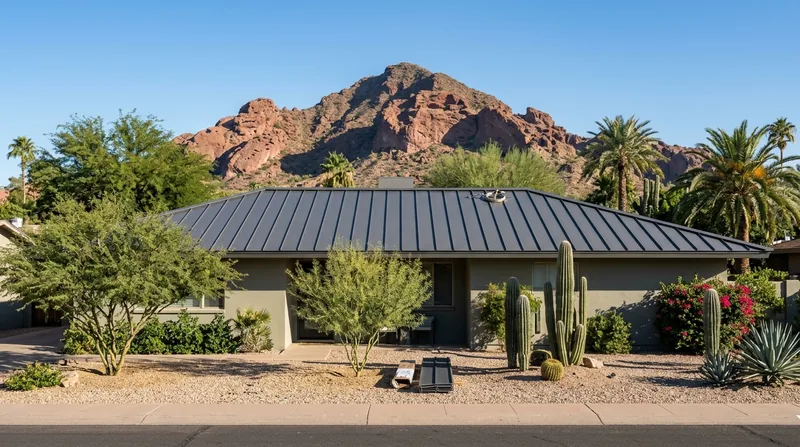




Standing Seam Metal Roofing in Phoenix is the system we install most on homes where the owner plans to stay put. The Valley floor sits at about 1,100 feet, ringed by Camelback, South Mountain and the McDowells, and the sun hits a low-slope roof hard from April through October. Panels here are roll-formed to length, mechanically seamed or snap-locked, and held down by concealed clips, so there are no exposed screws to back out as the roof heats and cools every single day. We measure the roof, order the panels to the exact run, and install over proper underlayment with the flashing detailed for monsoon wind. If you are still deciding between systems, start with our metal roof installation page, then come back to the seam details below.
Why Standing Seam Holds Up Better Than Anything Else on a Phoenix Roof
The failure that dominates in this city is heat cycling, not snow load and not coastal salt. A shingle roof in Maryvale or Central Phoenix takes 110 degree afternoons and 70 degree nights for months, and the sealant strips let go, the fasteners wallow out and the granules wash into the gutters. Standing seam takes that same cycle with a floating clip that lets the panel move. That is the whole reason the system lasts here.
- Concealed clips let the panel expand and contract without loosening a single fastener.
- Reflective finishes in light gray, white and cool bronze cut attic heat gain on west-facing slopes.
- Mechanically seamed panels resist the microburst winds that roll through the East Valley in July and August.
- Panels run long on low-slope ranch roofs, so there are fewer seams and fewer places for water to sit.
- The finish holds color under hard UV instead of chalking out in eight to ten years like painted exposed-fastener panels.
On a 1950s block-and-stucco ranch in Tempe with a 3:12 pitch, that combination is the difference between a roof you replace once and a roof you patch every summer.
Key info: In the historic districts near downtown (Willo, Encanto), panel profile and color can be reviewed by the city before a permit is issued. We check the design review requirements before we order a single panel, because a charcoal seam profile that passes in Ahwatukee may not pass on a contributing property in a historic overlay.
Permits for a re-roof are commonly required across Maricopa County jurisdictions, and the thresholds and inspection steps vary by city. Confirm the current rules with the City of Phoenix Planning and Development Department before work starts, and we will pull the permit and meet the inspector on site.
How We Install Standing Seam on a Phoenix Home, Step by Step
Every job starts with a real measurement, not a square-foot guess. We walk the roof, check the deck and the existing layers, and note every penetration: swamp cooler pads, skylights, the chimney chase, the patio tie-in. Then we order panels cut to the exact run so the seams land where they should and the waste stays low.
- We tear off to the deck and inspect for soft sheathing, especially on 1970s homes that had a foam or gravel roof before.
- We install a high-temp synthetic underlayment rated for desert heat, not standard felt that bakes and tears.
- We set eave trim, rake trim and the valley metal before the first panel goes down.
- We roll-form or stage the panels to length, lift them without kinking, and fasten the concealed clips to the deck.
- We seam or snap-lock the panels, then detail the ridge, hips and all penetrations with formed flashing.
- We pressure-check the seams and walk the roof with you before we call it done.
If your home already has shingles and the deck is sound, a retrofit may be an option; read the metal roof over shingles page before you decide, because code limits how many existing layers you can cover.
Local example: On an Arcadia ranch with a low-slope rear addition, we ran 24-gauge panels in a light reflective finish across the main house and tied the addition in with a custom transition flashing. The owner had been patching a leak at the wall junction every monsoon for six years. The seam system and the new transition ended the cycle in one visit.
Standing Seam Approaches We Use Across the Valley
Not every roof wants the same panel. Pitch, span, budget and the look of the house all push the decision, and we will tell you when a snap-lock panel is the right call and when the seam has to be mechanical.
| Approach | Description | Best for |
|---|---|---|
| Mechanically seamed | Panels joined with a raised double-lock seam, the tightest wind and water detail available. | Low-slope ranch roofs and homes on open lots with full monsoon exposure. |
| Snap-lock | Panels snap together over a concealed clip, faster to install with no seaming tool on the roof. | Steeper pitches on 1990s and newer stucco subdivisions in Gilbert and Chandler. |
| Reflective cool finish | Light gray, white or cool bronze coating that bounces solar gain instead of absorbing it. | West and south slopes where attic heat is the real complaint. |
| Charcoal and bronze profiles | Darker seam panels matched to Spanish Colonial Revival and territorial styling. | Biltmore and Arcadia homes where the color has to read correctly from the street. |
| Standing seam with copper accents | Steel field with copper on porch roofs, bay windows and small feature areas. | Historic-district homes and custom builds that want the copper look without the full copper budget. |
We will bring panel samples to the estimate so you can see the finish against your stucco in real daylight, not on a screen.
Standing Seam Metal Roofing Cost in Phoenix: What to Expect
Plan on a starting point of about $10 per square foot for a standing seam system, and understand that the number moves from there. Roof size, pitch, how many penetrations have to be flashed, whether we tear off existing layers, and the gauge and finish you pick all shift the final figure. A simple gable in Surprise costs less per square than a cut-up Arcadia roof with three valleys and a chimney chase.
- Roof complexity drives labor more than material, so hips, valleys and dormers raise the price.
- Panel gauge and finish selection move the material line, with 24-gauge and premium cool coatings at the top.
- Tear-off and deck repair add cost when the existing roof has soft sheathing or multiple shingle layers.
- Access matters, and a steep drive or a tight side yard changes how we stage panels and equipment.
- Flashing scope, including skylights, chimney chases and patio tie-ins, is priced from what we actually find.
Get two or three written estimates and compare the scope line by line, not just the bottom number. Our full pricing overview shows how we build the figure.
Standing Seam Metal Roofing Near Me: How to Vet a Contractor in the Phoenix Area
You will get plenty of knocks on the door after a monsoon, and most of them will not be around next summer. Then check references on homes that look like yours, because a contractor who is good on a tile subdivision in Queen Creek may not have run a long seam panel on a 1950s low-slope ranch in Mesa.
- Confirm the contractor is licensed and insured, and ask for the certificate to be sent to you directly.
- Get at least two or three estimates in writing with the panel gauge, finish and flashing scope spelled out.
- Ask who pulls the permit and who meets the inspector, and make sure the answer is the contractor.
- Check HOA design review rules in your subdivision before you pick a panel color or profile.
- Ask how the crew handles panel length and staging on your lot, since long panels need room to land.
When you are ready to talk through your roof, reach us through the contact page and we will set a time to walk it with you.
Key info: After a haboob or a July microburst, the calls we get are mostly about lifted ridge caps and wind-driven water at wall junctions, not seam failure. We document storm damage with photos and measurements so your insurance adjuster has what they need, and we never suggest a deductible can be waived or absorbed.
Standing seam is a long game: pay more now, stop patching later. Call Phoenix Metal Roofing at (623) 321-3532, and we will tell you straight whether your roof is a candidate or whether a different system fits your house better.
Standing Seam Metal Roofing in Phoenix: Pricing Guide
| Service | Price | Details |
|---|---|---|
| Standing seam, simple gable roof | Starting at $10/sq ft | Includes panels, concealed clips, underlayment, standard trim and flashing on a straightforward gable. |
| Standing seam, cut-up roof with valleys and hips | Starting at $14/sq ft | Covers added labor for multiple valleys, hips, dormers and complex flashing details. |
| Tear-off and deck repair | Quoted separately | Priced after we inspect the deck for soft sheathing and count existing shingle layers. |
| Copper or specialty metal accents | On estimate | Material cost and panel size vary widely, so we price from the actual drawings. |
| Travel | Included | In Phoenix and surrounding Valley communities, no separate call-out or mileage fee. |
| Estimate | Free | Response within 24h at (623) 321-3532, no obligation to book. |
Indicative pricing, the exact cost depends on square footage, finish, and site access. Free personalized estimate within 24h at (623) 321-3532.


