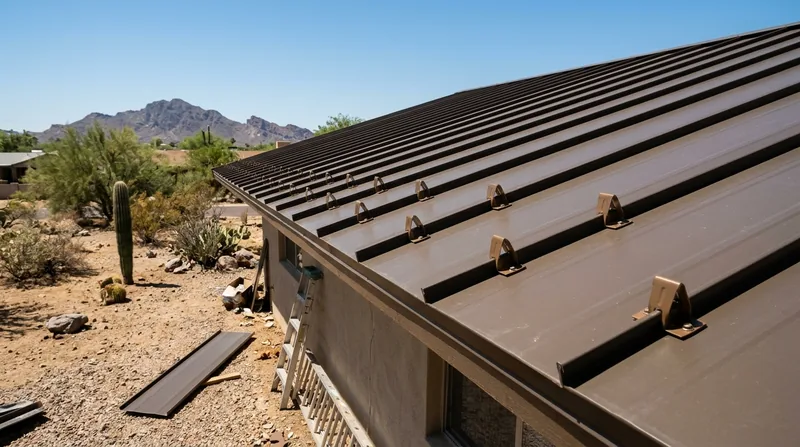




Snow Guards & Ice Protection in Phoenix: Honest Guidance for Valley and High-Country Roofs
Phoenix sits on the flat Sonoran Desert valley floor at about 1,100 feet, ringed by Camelback Mountain, South Mountain, the McDowell Mountains and Piestewa Peak, and snow is almost unknown down here. That is the first thing to understand about Snow Guards & Ice Protection in Phoenix: on most valley homes, you do not need them. Where they earn their keep is on steep metal roofs over entries and walkways, where packed hail can release in sheets, and on mountain cabins and second homes in the high country that Phoenix owners keep for weekend trips. We install pad-style and bar-style snow guards and rail systems on standing seam and exposed-fastener panels, and we tell you straight when your roof does not need them.
Valley homes here run from 1920s adobe-brick and stucco bungalows in Willo and Encanto to Spanish Colonial Revival tile roofs in Arcadia and the Biltmore area, plus 1990s to 2020s stucco subdivisions in Ahwatukee, Gilbert, Chandler and Queen Creek. Most of those roofs never see a snow load. If your real concern is storm damage, start with our storm and wind damage repair page instead.
Why Snow Guards Matter Differently in Phoenix Than Anywhere Else
In most of the country, snow guards hold back drifting snow. In the Valley of the Sun, the dominant failure mode is not snow at all. It is intense UV and 110-degree summer heat that bakes sealants, backs out fasteners and, on steep panels, lets packed hail and monsoon runoff slide fast onto patios, carports and entry walks. July through September monsoon storms drop sudden cloudbursts and occasional hail, and a steep R-panel carport roof can shed that load in one sheet.
- We survey steep metal panels over entries, patios and walkways where sliding hail or runoff is a real hazard.
- We check fastener condition first, because backed-out screws on a sun-baked roof make any guard system unreliable.
- We document high-country cabin roofs for owners who live in Phoenix and visit on weekends.
- We tell you when a valley roof does not need guards, which saves you money and clutter.
That honest assessment is the whole point of the service, and it is why we ask where the roof is before we quote anything.
Key info: A homeowner in Arcadia with a steep standing seam porch roof over a tiled entry walk asked about snow guards after a hail event. We inspected the fasteners, found three backed out from heat cycling, and recommended re-fastening plus a short bar-style rail over the walk instead of a full guard layout. The rail solved the slide problem at a fraction of the cost.
For the code side, roofing permits and inspection thresholds vary by jurisdiction across the Valley, so always confirm with the local building department. The City of Phoenix Planning and Development Department publishes current permit guidance at phoenix.gov/pdd.
How We Approach Snow Guards & Ice Protection on Phoenix-Area Roofs
We start with the roof itself, not with a product catalog. On a valley home, that means checking panel type, pitch, fastener condition and what sits below the drip line. On a high-country cabin, it means measuring snow load expectations and mapping where snow will release. Then we recommend the least hardware that solves the actual problem.
- We inspect the roof in person and identify the panel profile, whether standing seam or exposed-fastener R-panel.
- We check fastener tightness and sealant condition, since heat cycling is the top cause of loose screws here.
- We map the slide zone: entries, walkways, patios, carports and anything people walk under.
- We recommend pad-style guards, bar-style rails or no hardware at all, and explain the reasoning.
- We install with clamps or fasteners matched to the panel, never through the seam on a standing seam roof.
- We walk the roof with you at completion and show you what was installed and why.
Each step is documented so you can hand the record to an insurer or a future buyer.
Key info: A Queen Creek horse property with an R-panel workshop roof had a steep lean-to over the equipment bay. Hail and monsoon runoff were dumping onto the concrete apron where the owner parks a tractor. We installed clamp-on bar rails on the lean-to only, left the main low-slope roof alone, and the owner avoided paying for guards across the whole building.
If your panels are older and the real issue is loose fasteners, our screw replacement and re-fastening service is usually the first call before any guard work.
Snow Guard and Rail Options We Install
There is no single right system. The panel profile, the pitch and what sits below the roof decide which hardware makes sense, and on many Phoenix valley roofs the answer is a rail over one entry rather than guards across the whole plane.
| Approach | Description | Best for |
|---|---|---|
| Pad-style snow guards | Individual clamped or fastened pads spaced across the panel to break up sliding loads. | Standing seam and metal shingle roofs on high-country cabins with real snow load. |
| Bar-style rail systems | Continuous rails mounted above the panel to catch and hold sliding hail or runoff. | Steep valley roofs over entries, patios and walkways where hail slides fast. |
| Clamp-on seam mounts | Non-penetrating clamps that grip the standing seam without piercing the panel. | Standing seam roofs where the owner wants no new fastener holes. |
| Fastened guards on R-panel | Screw-mounted guards sized to the rib spacing on corrugated and ribbed panels. | Carports, patios and outbuildings with exposed-fastener roofs. |
| No-hardware assessment | Written finding that the roof does not need guards, with the reasoning stated. | Low-slope valley roofs where guards would be wasted money. |
Snow Guards & Ice Protection Cost in Phoenix: What to Expect
Most valley jobs we quote start from $1,200, and that figure usually covers a modest run of rail or guards over one entry or walkway, including clamps and labor. A full guard layout across a steep cabin roof, or a larger high-country job, runs higher because hardware count, roof pitch, travel and access all climb together. Steep pitches and tall walk-under zones slow the work and add safety rigging.
Three factors move the number most: the length of the slide zone you are protecting, the panel profile (clamp-on seam mounts cost more than screwed guards on R-panel), and whether the fasteners underneath need attention first. We quote the guard work and any re-fastening separately so you can see what each part costs. Our full pricing overview breaks down the ranges in more detail.
Get two or three estimates and compare scope, not just the bottom line. A quote that skips the fastener check is not the same job as one that includes it.
Choosing a Metal Roofing Contractor Near Phoenix for Guard and Rail Work
Guard and rail work is small-dollar compared to a full re-roof, which is exactly why some contractors skip the inspection and sell hardware by the box. Ask questions before you sign. Verify the license and insurance, ask for references on metal roofs specifically, and confirm who pulls any permit the local building department requires.
- Confirm the contractor is licensed and insured and ask for a certificate before work starts.
- Get two or three written estimates that state the hardware, the length of run and whether fastener checks are included.
- Ask for references from metal roof jobs in the Valley, not just shingle work.
- Check HOA design rules in subdivisions like Desert Ridge or Ahwatukee before any visible hardware goes on.
- Confirm permit responsibility with the local building department, since thresholds vary by jurisdiction.
A contractor who answers these plainly is the one to hire. Reach us through our contact and free estimate page when you are ready.
Snow Guards & Ice Protection in Phoenix: Pricing Guide
| Service | Price | Details |
|---|---|---|
| Single entry rail run | Starting at $1,200 | Covers a short bar-style rail over one entry or walk, including clamps and labor, on a standard pitch. |
| Pad-style guards, cabin roof | Starting at $1,800 | Pad guards across a steep high-country cabin roof, priced by hardware count and roof pitch. |
| Clamp-on seam mount system | Starting at $2,200 | Non-penetrating seam clamps on standing seam, priced by linear feet and seam spacing. |
| Guard work plus re-fastening | On estimate | Needs an on-site look because fastener condition and panel profile change the scope. |
| Travel | Included | In Phoenix and surrounding areas, no separate call-out or mileage fee. |
| Estimate | Free | Response within 24h at (623) 321-3532, no obligation to book. |
Indicative pricing, the exact cost depends on square footage, finish, and site access. Free personalized estimate within 24h at (623) 321-3532.


