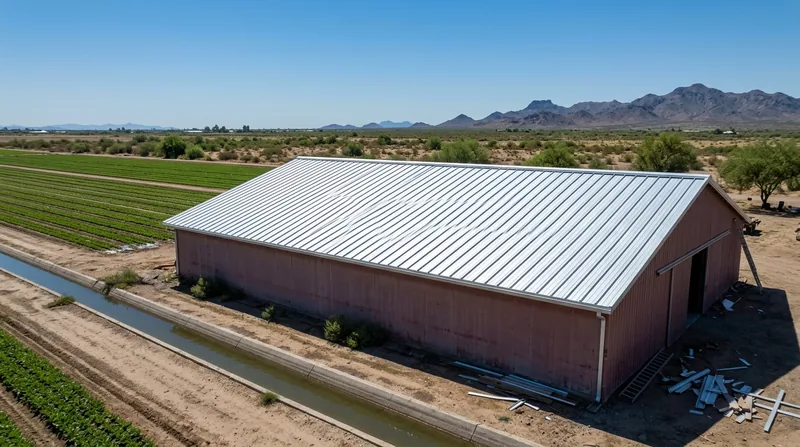




Commercial & Agricultural Metal Roofing in Phoenix
Phoenix sits on the flat Sonoran Desert valley floor at roughly 1,100 feet, ringed by Camelback Mountain, South Mountain, the McDowells and Piestewa Peak. That geography matters for commercial and agricultural metal roofing in Phoenix because the same intense UV, 110 degree summers and July to September monsoon microbursts hit every barn, workshop, church and light commercial building across the Valley. Commercial & Agricultural Metal Roofing in Phoenix is a different animal from a residential re-roof: bigger spans, exposed fastener panels, insulation, and equipment on the roof. We build and repair these systems for horse properties and citrus groves on the far southeast side, west Valley shops and warehouses, and carports and outbuildings from Glendale to Gilbert. If you are weighing panel types first, start with our corrugated and ribbed panel roofing page, then call (623) 321-3532 for a free estimate.
Why Commercial and Agricultural Metal Roofing Fails Faster in the Phoenix Valley
The dominant failure mode here is not snow load or coastal corrosion. It is heat cycling and UV. A metal panel on a west Valley shop can swing 40 to 50 degrees between a July afternoon and a clear winter night, and that expansion and contraction works fasteners loose year after year. Add haboob dust packing into laps and monsoon rain driving sideways at 60 mph, and the weak points show up fast: backed-out screws, worn neoprene washers, open seams and failed sealant at penetrations.
- Exposed-fastener R-panel on carports and outbuildings backs screws out from thermal cycling, so re-fastening becomes a routine maintenance item.
- Flat and low-slope roofs on older block-and-stucco commercial buildings in Maryvale and Central Phoenix pond water during cloudbursts and find every seam.
- Monsoon microbursts peel edge panels and lift ridge caps on buildings that were never edge-metal detailed for 70 mph gusts.
- UV degrades sealants and washer gaskets in three to five years on uncoated panels, long before the steel itself is compromised.
- Barns and workshops with no insulation turn into ovens, pushing interior temperatures well past ambient and stressing contents and equipment.
None of this means the roof is finished. It means the system needs the right panel, the right fastener and a maintenance plan built for desert heat.
Key info: On a horse property outside Queen Creek, we routinely find 15-year-old R-panel barn roofs with 30 to 40 percent of the screws backed out but the panels still sound. Re-fastening with larger-diameter screws and new washers costs a fraction of a tear-off.
Roofing permits are commonly required for a full replacement or re-roof in Valley jurisdictions, and thresholds, fees and inspection requirements vary by city. Always verify with the local building department before work starts. The City of Phoenix permit portal is a good starting point: Phoenix Planning and Development.
How We Approach a Commercial or Agricultural Metal Roof in Phoenix
Every job starts on the roof, not on a clipboard in the truck. We measure panel runs, check purlin spacing and substrate condition, photograph every penetration, and ask how the building is actually used. A citrus packing shed in Chandler and a church in Glendale need different answers even when the square footage matches.
- We walk the roof and document panel condition, fastener back-out, seam and flashing failures, and any ponding or drainage issues.
- We check the structure underneath, because purlin spacing and deck condition decide whether a retrofit panel can go over what is there.
- We recommend a panel system and insulation package matched to the building use, from bare R-panel on a hay barn to insulated standing seam on a light commercial office.
- We pull the permit with the local building department and schedule the inspection sequence before the crew mobilizes.
- We install with edge metal, closures and fasteners detailed for monsoon wind uplift, then walk the finished roof with you.
The same crew handles repairs and re-fastening on systems we did not install, which matters on older west Valley buildings where the original installer is long gone.
Key info: A 6,000 sq ft warehouse near Peoria had ponding at two roof drains and rusted-out panels at the gutter line. We replaced the failed panels, re-detailed the drains and added a coating over the sound steel, avoiding a full tear-off. See our metal roof coating and painting service for that restoration path.
Panel Systems and Approaches We Use Across the Valley
Panel choice on a commercial or agricultural building drives cost, lifespan and how much maintenance you sign up for. Here is how the main options compare for Phoenix conditions.
| Approach | Description | Best for |
|---|---|---|
| Exposed-fastener R-panel | Screw-down ribbed panels with washers, fast to install and easy to repair | Barns, workshops, carports and outbuildings on larger lots |
| Standing seam | Concealed-fastener panels with raised seams, no exposed washers to fail | Light commercial, churches and buildings where leaks are costly |
| Insulated panel system | Metal panels over rigid insulation or a liner, cutting heat gain | Workshops, packing sheds and climate-sensitive storage |
| Retrofit over existing roof | New panels over sound existing roofing where code allows the layer count | Older commercial buildings with one existing roof layer |
| Repair and re-fastening | Screw replacement, new washers, seam and flashing repair on sound panels | Buildings with good steel but backed-out fasteners and leak points |
Recover over existing roofing is limited by code to a set number of existing layers, so we verify what is on the building before quoting a retrofit.
Commercial & Agricultural Metal Roofing Cost in Phoenix: What to Expect
Every commercial and agricultural metal roofing cost in Phoenix starts with a free estimate, and that is the only number worth trusting. Panel type, span, insulation, access and how much tear-off is involved move the price more than square footage alone. A bare R-panel over an open barn frame in Buckeye prices very differently from an insulated standing seam system on a church in Glendale with HVAC units to flash around.
- Panel profile and gauge are the biggest single driver, with standing seam running well above exposed-fastener R-panel.
- Insulation and liner packages add cost but cut summer heat gain on workshops and storage buildings.
- Tear-off and disposal of existing roofing, plus deck or purlin repairs found underneath, add labor and dump fees.
- Access matters: a building hemmed in by equipment, fencing or a tight lot slows the crew and raises the number.
- Penetrations, skylights, HVAC curbs and parapet flashing add detail work that is priced per unit.
Get two or three estimates and compare scope line by line, not just the bottom line. A low bid that skips edge metal, closures or insulation is not the same job. Our full pricing overview breaks down what drives each line item.
Hiring a Metal Roofing Contractor Near Me in Phoenix: What to Check
Commercial and agricultural work attracts out-of-state storm chasers after every monsoon season. Before you sign, confirm the contractor is licensed and insured for the scope, ask for the certificate and verify it with the Arizona Registrar of Contractors. Ask for references on buildings like yours, not just residential re-roofs.
- Confirm active licensing and general liability plus workers compensation coverage, and get the certificate in writing.
- Get two or three written estimates with the same scope so the comparison is real.
- Ask for references on commercial or agricultural buildings in the Valley and call them.
- Understand the permit path with the local building department and who pulls it.
- Check HOA or historic district design review if the building sits in a regulated area, since panel profile and color can be restricted.
If a contractor cannot show you a certificate or explain the permit sequence, keep looking. Reach us through our contact and free estimate page or call (623) 321-3532.
Commercial & Agricultural Metal Roofing in Phoenix: Pricing Guide
| Service | Price | Details |
|---|---|---|
| Roof inspection and written report | Free estimate | On-site walk, photos of fastener and flashing condition, and a written scope with no obligation |
| Screw replacement and re-fastening | Starting at $1,200 | New larger-diameter screws and washers on backed-out panels, priced by roof square footage and access |
| Exposed-fastener R-panel installation | Starting at $8.50 per sq ft | Screw-down ribbed panels with closures and edge metal, moving up with insulation and tear-off |
| Standing seam installation | Starting at $14 per sq ft | Concealed-fastener panels with raised seams, priced higher for complex roofs and HVAC detailing |
| Insulated panel system | On estimate | Rigid insulation or liner under metal, needs an on-site look at purlin spacing and building use |
| Travel | Included | In Phoenix and surrounding Valley cities, with no separate call-out or mileage fee |
Indicative pricing, the exact cost depends on square footage, finish, and site access. Free personalized estimate within 24h at (623) 321-3532.


